
Spring can change the way vehicle owners think about cleaning, maintenance and presentation.
For a mobile detailing business, this creates an opportunity to review more than just the number of people searching for car detailing. The type of vehicles in an area, the distances between customers, the services they may need and the time of year can all affect how a territory should be approached.
For anyone considering a car detailing business in Australia, the key question is not simply, “Is there demand for detailing?”
A more useful question is:
“What combination of customers, vehicles, services and travel patterns could make this territory practical to operate?”
This approach can help prospective franchise owners assess a location before deciding which services to promote most heavily.
Why Spring Matters for Mobile Detailing
Spring is a useful point in the calendar for reviewing detailing demand because vehicle owners may have different priorities after winter.
Some customers may be looking for a general interior and exterior clean. Others may be preparing a vehicle for sale, getting a caravan ready for travel or considering paint protection before the hotter months.
However, seasonality should not be treated as proof that a particular service will sell in every location.
A territory should be assessed using local evidence. Search behaviour, customer enquiries, vehicle types, existing competitors, travel times and actual booking patterns can provide a clearer picture than assumptions about what people in a suburb or city “should” want.
This is particularly important for a mobile business because the territory is not simply a point on a map. It is the area an operator can realistically travel between jobs while maintaining productive working days.
Start With the Customer and Vehicle Mix
The first step in evaluating a detailing territory is understanding who lives, works and owns vehicles in the area.
A territory could include:
- Family vehicle owners
- New vehicle owners
- Used vehicle owners
- Luxury and performance vehicle owners
- Caravan and motorhome owners
- Boat owners
- Motorcycle owners
- Commercial vehicle operators
- Customers preparing vehicles for sale
- Businesses with multiple vehicles
The proportions will vary between locations.
This means a service menu should not be built entirely around a generic national assumption. A prospective operator can instead identify the vehicle and customer groups present in the territory and then investigate which services could match them.
Australia’s Detailing Group offers a broad service mix that includes car detailing, paint correction, cut and polish, ceramic protection, caravan and motorhome detailing and boat detailing. Its franchise information also states that training covers multiple vehicle and detailing services.
Use Search Data as a Starting Point, Not the Whole Answer
Search demand can help identify what customers are looking for.
The keyword research supplied for this article shows estimated Australian search volumes for terms including:
- “car detailing near me” at 9,900 monthly searches
- “car detailing” at 8,100
- “car detailing Melbourne” at 1,600
- “vehicle detailing Brisbane” at 1,600
- “car detailing Brisbane” at 1,300
- “car detailing Adelaide” at 1,300
These figures are Semrush AU estimates and should be treated as directional search data rather than a forecast of bookings or revenue.
The important point is that local searches can reveal geographic intent.
Someone searching for “car detailing Melbourne” has a different intent from someone searching for general information about vehicle detailing. Similarly, “car detailing near me” indicates that location is an important part of the search.
For a prospective franchise owner, this makes local SEO, Google Business Profile activity and well-built location pages relevant parts of territory research.
Australia’s Detailing Group currently operates location pages across multiple states and uses its website to connect customers with local mobile detailers.
Build a Territory Around Drive Time
Mobile detailing has one major difference from a fixed workshop.
The operator travels to the customer.
That means drive time needs to be included in territory planning.
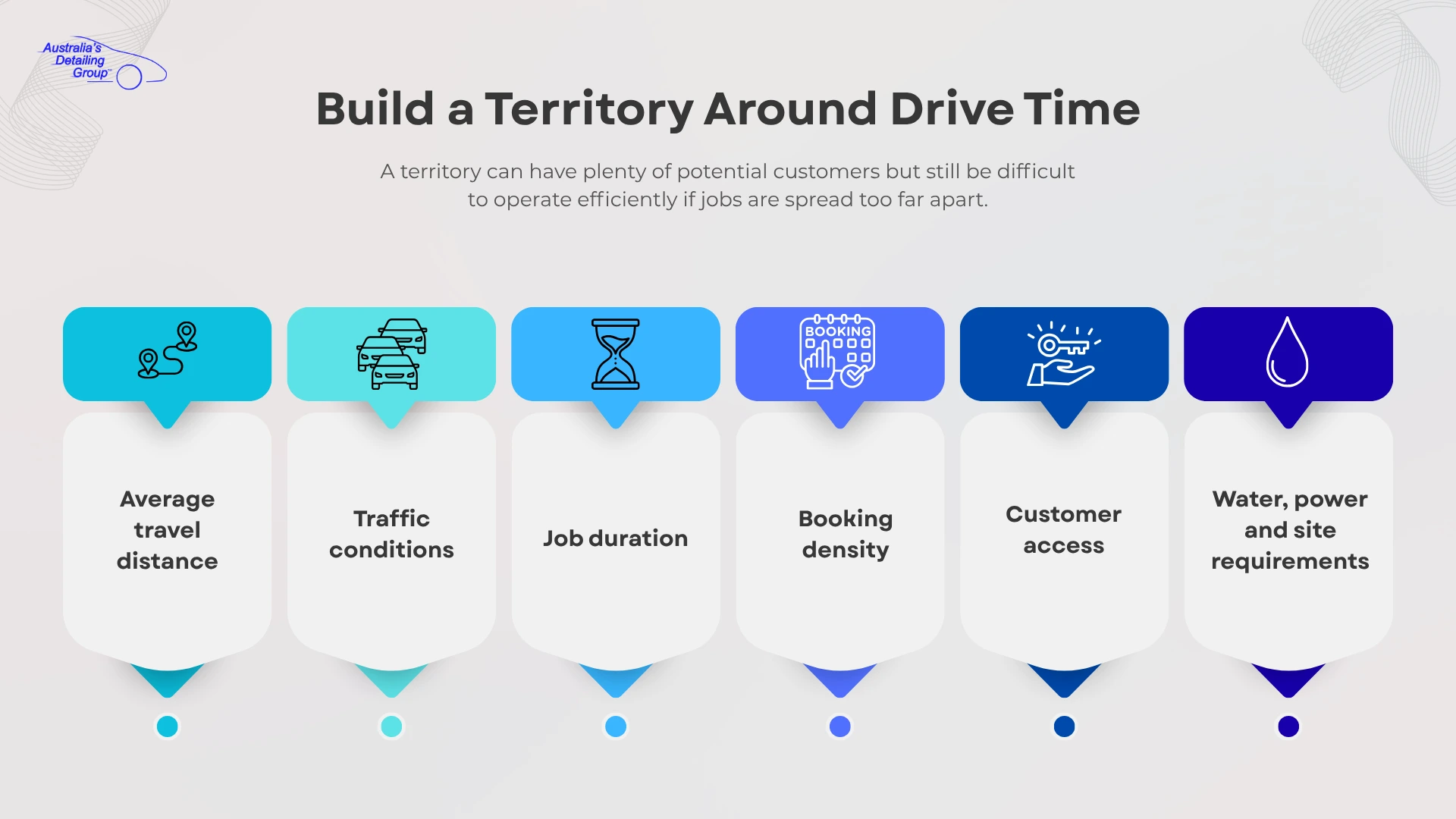
A territory can have plenty of potential customers but still be difficult to operate efficiently if jobs are spread too far apart.
When assessing a territory, consider:
1. Average travel distance
How far would the operator normally travel between bookings?
2. Traffic conditions
A short distance on a map can take much longer during peak periods.
3. Job duration
A larger detailing job may justify more travel than a short maintenance service.
4. Booking density
Several bookings in nearby suburbs can create a more efficient working day than individual jobs spread across a wide area.
5. Customer access
Can the operator safely and practically work at homes, workplaces or other approved locations?
6. Water, power and site requirements
Different services can have different equipment and site requirements. These should be understood before offering a service across a territory.
Australia’s Detailing Group describes its model as mobile, with detailers travelling to customers at home or work. Its franchise information also states that territories are reviewed based on factors including location, surrounding suburbs, travel considerations and the existing franchise network.
Match Services to the Territory
Once the customer and vehicle mix has been researched, the next step is to consider the service mix.
A practical service mix can include several levels of work.
Everyday detailing
Standard interior and exterior detailing can form part of the regular customer base.
These services may also create opportunities for repeat bookings when customers return for ongoing vehicle care.
Full detailing
Full details can address multiple areas of the vehicle at once and may suit customers who want a more comprehensive service.
Pre-sale detailing
Pre-sale preparation has a specific commercial purpose.
The customer is preparing a vehicle for photographs, inspections and potential sale. This makes timing important because the booking is connected to another transaction.
The service should be quoted according to the vehicle’s condition and the work required rather than promising a particular sale price or outcome.
Paint correction and cut and polish
These services require more assessment than a standard wash.
The operator needs to understand the condition of the paintwork, what can reasonably be improved and which process is appropriate.
Ceramic paint protection
Ceramic protection can add another service category for suitable vehicles.
Professional preparation is important because coating application is not simply a matter of applying a product to unprepared paint.
Caravan and motorhome detailing
Larger recreational vehicles can require different equipment, preparation and working times from standard cars.
This means they should be considered as part of the territory’s vehicle mix rather than simply added to a service menu without planning.
Boat detailing
Boat detailing can also broaden a mobile operator’s potential service mix where access, site conditions, equipment and training make the work practical.
The aim is not to offer every possible service in every territory.
The aim is to build a service mix that matches the local customer base and can be delivered efficiently.
How Spring Can Change the Service Mix
Spring can provide useful prompts for reviewing how services are marketed.
For example, a customer who has not cleaned the interior of a vehicle throughout winter may now be more interested in a full detail.
Another customer may be preparing a caravan for upcoming travel.
A vehicle owner considering selling their car may need pre-sale preparation.
Someone who has recently purchased a new vehicle may be researching paint protection.
These are useful marketing hypotheses.
They are not evidence that every territory will experience the same pattern.
The operator should monitor enquiries and bookings to find out which seasonal messages actually produce customer interest in their area.
Consider Repeat Frequency
A service can have a good booking value without being a frequent purchase.
This is why repeat frequency should be considered alongside price.
For example:
- Maintenance detailing: potentially suited to repeat customers.
- Full detailing: may be booked less frequently depending on the customer and vehicle.
- Pre-sale detailing: linked to a specific sales event.
- Ceramic protection: generally connected to a particular protection decision rather than a routine weekly or monthly service.
- Caravan detailing: may be seasonal or linked to travel and maintenance cycles.
- Boat detailing: may also be influenced by season, storage and use.
A balanced service mix can help an operator avoid relying entirely on one type of customer or booking.
Look at Service Margin and Time
Revenue alone does not show whether a service fits a mobile business.
An operator should consider the relationship between:
- Price
- Labour time
- Product costs
- Equipment requirements
- Travel time
- Setup and pack-down
- Customer communication
- Follow-up
- Rework risk
- Site requirements
For example, two services may have similar booking prices but very different labour and travel requirements.
A useful territory assessment therefore asks:
How much productive working time does each service create after travel and operating costs are considered?
This is one reason a varied service mix can be useful.
It allows the operator to compare different types of work rather than building the entire business around a single package.
Check Workshop Requirements Before Adding Services
A mobile business can provide many services without operating from a traditional workshop, but not every job will be suitable for every location.
Before adding a service, check:
- Vehicle size
- Access
- Weather exposure
- Power requirements
- Water requirements
- Wastewater considerations
- Surface and drainage
- Customer site rules
- Local regulations
- Equipment requirements
- Operator training
Australia’s Detailing Group states that its mobile model is designed around servicing customers at their location, while franchisees must also comply with relevant permits, registrations, site rules and safe working requirements.
This makes site assessment an important part of territory planning.
How Australia’s Detailing Group Territories Are Reviewed
Australia’s Detailing Group states that franchise availability changes and that prospective franchisees can discuss their preferred location with the business.
The current national franchise page lists opportunities including Brisbane Central, North Lakes, Caboolture, Gold Coast, Mount Gravatt, Sunshine Coast, Greater Sydney, Hobart, Melbourne and Adelaide, among others. The available locations are updated regularly.
The franchise process includes an area availability check before the franchise package and terms are reviewed.
This is important because a location that appears available online may need to be assessed against existing operators, territory boundaries and current network plans.
A prospective franchisee should therefore confirm the current position directly rather than relying on an old list of available suburbs.
Choosing a Service Mix Is an Ongoing Process
The right service mix does not have to be fixed permanently.
A business can monitor:
- Which services generate enquiries
- Which enquiries convert into bookings
- Which services take the most time
- Which services generate repeat customers
- Which suburbs produce the most work
- Which services are seasonal
- Which services require additional equipment
- Which customer groups respond to specific marketing
This information can then inform future local campaigns.
For example, if a territory receives regular enquiries about caravan detailing, the operator may decide to create more caravan-focused content.
If pre-sale work generates enquiries from used vehicle owners, local content can address preparing a vehicle for sale.
If maintenance detailing produces repeat bookings, customer retention can become a larger part of the marketing strategy.
The process should be based on actual territory data rather than assumptions.
What This Means for Someone Considering a Car Detailing Franchise
A car detailing franchise territory should be assessed as a business system rather than simply a postcode.
The key questions are:
- Who are the customers?
- What vehicles do they own?
- Which services could suit those vehicles?
- How far will the operator need to travel?
- Which services can be completed efficiently on site?
- Which services could generate repeat work?
- How seasonal is the opportunity?
- What does the local competition offer?
- What does the search data show?
- Is the territory currently available?
This approach can help turn a broad idea such as “I want a mobile car detailing business in Brisbane” into a more specific territory and service plan.
Explore Current Australia’s Detailing Group Franchise Territories
Australia’s Detailing Group provides mobile detailing franchises across multiple Australian states and supports franchisees with training, equipment, operational systems and marketing support. The current franchise page lists available territories and explains that availability changes over time.
If you are considering a territory, the next step is to discuss the location directly and review the available information before making a decision.
You can explore the current franchise opportunities by state:
- Queensland: https://austdg.com.au/car-detailing-franchises-queensland/
- Victoria: https://austdg.com.au/car-detailing-franchises-vic/
- South Australia: https://austdg.com.au/car-detailing-franchises-south-australia/
- Australia-wide franchise opportunities: https://austdg.com.au/car-detailing-franchises/
Territory availability, costs, finance arrangements and franchise terms can change, so prospective franchisees should request the current information pack and discuss their preferred service area directly with Australia’s Detailing Group.
Frequently Asked Questions
What services should I offer in a mobile car detailing business?
The service mix should reflect the vehicles, customers, travel patterns, site conditions and commercial requirements of the territory. Services can include maintenance detailing, full detailing, pre-sale preparation, paint correction, ceramic protection, caravan and motorhome detailing and boat detailing.
Is spring a good time to review a detailing service mix?
Spring can provide useful seasonal marketing opportunities because customer priorities may change around vehicle presentation, travel and maintenance. However, seasonal assumptions should be tested against actual local enquiries and bookings.
How do I choose a car detailing franchise territory in Australia?
Consider customer density, vehicle types, search behaviour, travel times, competition, seasonality, repeat booking potential, service requirements and the availability of suitable mobile working locations. You should also confirm whether the territory is currently available.
Should a detailing business focus on one service?
Not necessarily. A broader service mix can provide access to different customer needs and booking types. The appropriate mix depends on the territory, operator capability, equipment, training and customer demand.
Is caravan detailing a good service to investigate?
Caravan detailing can be investigated where the local vehicle mix, access, travel patterns and customer enquiries support it. It should be treated as a territory-specific opportunity rather than assumed to have the same demand across Australia.
How important is drive time for a mobile detailing business?
Drive time can directly affect how many jobs an operator can complete and how efficiently the working day is used. It should therefore be included when assessing a territory and pricing or scheduling services.
Does Australia’s Detailing Group have car detailing franchise territories across Australia?
Australia’s Detailing Group currently lists franchise opportunities across multiple states, including Queensland, New South Wales, Victoria, South Australia, Western Australia and Tasmania. Available territories change, so current availability should be confirmed directly with Australia’s Detailing Group.
How can I find out if my area is available?
You can submit a franchise enquiry and provide your preferred postcode or service area. Australia’s Detailing Group states that the location is reviewed as part of the enquiry process before the franchise details and terms are considered.